
.jpeg?trim=192,0,193,0&width=752&height=501&crop=752:501)
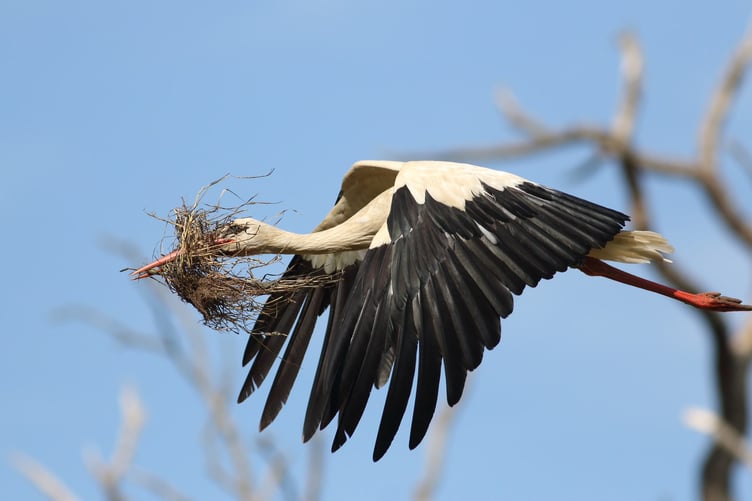
White storks bring good luck and deliver babies, say fairytales. But to see these magnificent birds in the wild us Brits used to have to travel to southern Europe or sub-Saharan Africa.
It’s therefore big news to Surrey birdwatchers that a group of these impressive birds has appeared locally, in the Burpham area.
Ed Stubbs of the Surrey Bird Group told me the group’s numbers have fluctuated, peaking at 11.
“They commute between the water meadows along the River Wey at Burpham and the Slyfield tip, as well as further north towards Jacobs Well, where a pair have built a nest,” he said.
Although white storks have been visiting Britain from the Continent, there were no breeding white storks in Britain for more than 600 years. That has changed, thanks to a rewilding conservation project by the White Stork Project, based at the Knepp Estate in East Sussex.
It began in 2016 with a group of white storks that could no longer fly. They were based in a protective enclosure, including a pond and meadow for them to forage in. They attracted wild storks, leading to successful breeding there.
The birds have been ringed to track their movements across Southern England and abroad.
.jpeg?width=209&height=140&crop=209:145,smart&quality=75)



Ed explained: “Two pairs nested at Knepp for the first time in 2020. Since then, records of birds in the wider region beyond Knepp have increased significantly.
“Wild white storks have always been very rare in Britain. The last white stork accepted as wild by the Surrey Bird Club was in 2016.”
Ed added that most of the birds seen recently around Burpham are ringed and have been confirmed to have come from Knepp, including one of the nest builders.
The White Stork Project is run by Knepp Wildland Foundation, a charitable foundation based at the Knepp Estate.
The project team is headed by White Stork Project manager, Laura Vaughan-Hirsch, who oversees the daily care and feeding of the storks at Knepp, and the monitoring of two colonies at Knepp and Wadhurst.
Laura has visited the Burpham storks, and told me: “Most of them are Knepp-hatched birds from over the last couple of years who have been off on migration.
“A couple were originally from Cotswold Wildlife Park, who are partners in our project and release captively bred storks at Knepp to help bolster our growing colony. Most of the birds in the Guildford group are ringed so we can identify them and we know how old they are and where they have been.
“Interestingly we have reports of two unringed birds. These may be wild birds from the Continent.
“The nest has been built by ‘GBG7’, a male bird hatched in 2023 at Cotswold Wildlife Park who has been seen in Morocco, so he has completed an amazing migration. He appears to have partnered with an unringed female.
“It’s normal for storks to build a ‘practice nest’ in their first breeding year, which we believe is the case with GBG7. Typically, white storks will put such a nest together but not rear anything, then return to it the following year and rear young.
“It’s incredibly exciting to see white storks colonising new areas beyond Knepp. It’s what we’ve always hoped for from the White Stork Project.
“The storks’ presence along the River Wey is a powerful sign that habitat restoration is creating opportunities for wildlife to thrive, and gives real hope for the establishment of a new wild breeding population in Britain.”
Comments
We've recently changed our login process. If you have an account for commenting, you will need to re-register on the login window.
This article has no comments yet. Be the first to leave a comment.