
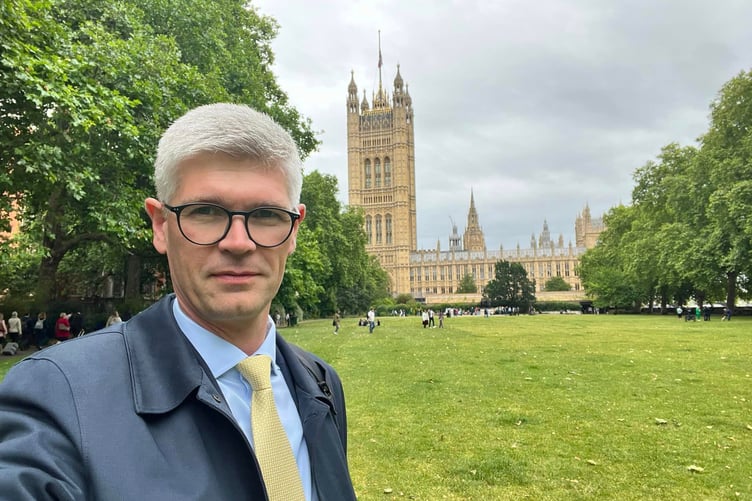
No one seriously disputes that Frimley Park Hospital needs replacing.
The current hospital is riddled with RAAC concrete and approaching the end of its useful life. Patients, staff and our wider community deserve a modern hospital fit for the future.
That is why I support a new Frimley Park Hospital.
What I do not support is the proposal to build it on Frimley Fuel Allotments, including land currently occupied by Pine Ridge Golf Club.
For more than a year, I have been warning that this was the direction of travel. I hoped I was wrong. Unfortunately, the announcement on 16 June confirmed my fears when Frimley Health identified Frimley Fuel Allotments as its preferred location for the new hospital.
My objection is not to a new hospital. It is to the loss of one of the most historically significant and environmentally valuable parts of our area.
The land in question is not simply an empty field waiting to be developed. It is the last substantial remnant of the ancient Frimley Common, enclosed in 1801 after centuries of use by local people and today is administered under the Frimley Fuel Allotments charity.
In a constituency that has seen relentless development over recent decades, it remains one of the few surviving links to our shared history - but for how much longer under the FFA's faltering and wrong-headed stewardship?
Once it is gone, it is gone forever.
That alone should give us pause. But heritage is not the only issue.



A hospital should be located where it is most accessible to patients, visitors and staff. Yet many residents are struggling to understand how moving the hospital away from its current location and placing it behind multiple schools and on an irreversibly-congested road network achieves that aim.
Anyone who regularly uses the A30, the Maultway, or the surrounding roads knows how congested they can become. Residents are therefore entitled to ask what evidence exists to demonstrate that this location will improve access rather than make existing problems worse.
Questions also remain about public transport, emergency access, workforce travel and the wider infrastructure required to support a development of this scale.
What has been announced is not yet a final decision. Frimley Fuel Allotments is the Trust’s preferred site, and a 13-week public consultation is now underway.
In principle, that consultation should provide an opportunity for local people to influence one of the most important public infrastructure projects our area has ever seen.
Yet many residents are left wondering what exactly is being consulted upon.
The concern is straightforward. Frimley Health has repeatedly stated that it assessed numerous locations before concluding that Frimley Fuel Allotments was the only technically viable option. If that is the case, then how open is the consultation to a different outcome?
A meaningful consultation should allow decision-makers to rethink a proposal if the evidence points in a different direction. It should not simply invite residents to comment on the details of a scheme whose central premise has already been settled.
Perhaps the most troubling aspect of the process is the apparent absence of a credible alternative.
If Frimley Fuel Allotments is genuinely the only viable site, then what happens if the proposal proves undeliverable? What happens if planning obstacles emerge, costs escalate, infrastructure requirements become prohibitive, or public opposition proves overwhelming?
Major infrastructure projects require contingency planning. Yet from everything currently in the public domain, there appears to be no obvious Plan B.
That should concern everyone - including those who support the relocation.
Frimley Park Hospital serves communities across Surrey, Hampshire and Berkshire. The stakes are simply too high to rely upon a single option while assuring residents that a consultation remains open. Doing so risks creating the impression that the destination has already been decided and that the discussion is merely about the route taken to get there.
To put it another way: if Frimley Fuel Allotments is genuinely the only viable option, then residents are entitled to ask whether this consultation is about choosing a site at all - or simply about choosing the colour of the wallpaper.
That is not how public confidence is built.
If Frimley Health wishes to build trust, it should publish in full the evidence behind its decision, including the traffic modelling, environmental assessments, cost comparisons with alternative sites and the criteria used to reject them. It should also explain clearly what alternatives remain available if this proposal cannot proceed.
Over recent weeks I have joined local residents on walks across the site and listened to their concerns. I have also supported the campaigns of the Heatherside Ward Residents Association and the Protect Frimley Fuel Allotments group, whose petition has attracted more than 14,000 signatures.
Their message is straightforward: build the hospital, but do not build it here.
I agree.
Our community needs a new hospital. But it should not come at the cost of sacrificing the last remaining part of the ancient Frimley Common, nor should residents be expected to accept a process that increasingly appears to be asking them to comment on a decision that has already been made.
The right hospital is essential.
This is simply the wrong place to put it.
Comments
We've recently changed our login process. If you have an account for commenting, you will need to re-register on the login window.
This article has no comments yet. Be the first to leave a comment.