
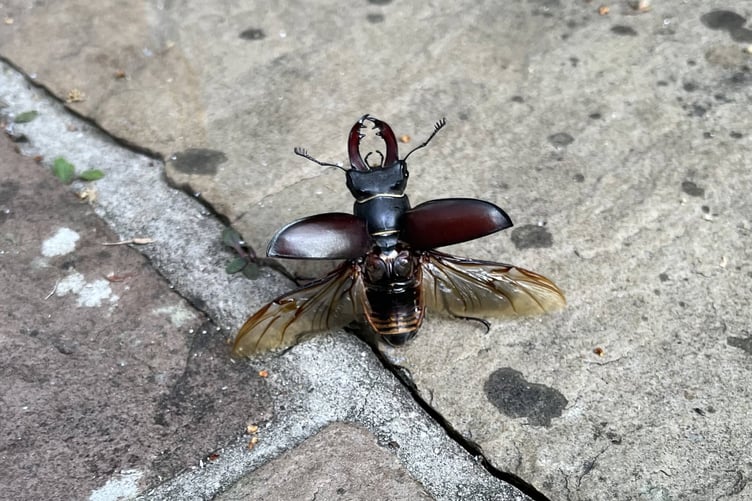
It’s stag beetle time! I was reminded of the summertime appearance of these huge insects by reader Frances Hagger, who emailed recently to report an evening sighting of one flying in Woking Park.
Frances had emailed me a year ago in response to my article about The Great Stag Hunt – a citizen science survey run by wildlife charity People’s Trust for Endangered Species (PTES).
That annual survey is now “live” again: PTES asks people across Britain to take part by telling them about their sightings of stag beetles, as the data they help to collect make a valuable contribution to stag beetle conservation efforts. Please tell me at the News & Mail as well, especially if you have a photo!
This year, for the first time, PTES also asks for video or audio clips of spectacular stag beetles in flight.
Stag beetles are Britain’s largest insects and mostly found in southern England, but there are hotspots in the Severn Valley and in coastal parts of the south west.
Last year, more than 12,000 records of stag beetles were submitted to PTES by thousands of volunteers, with over 2,500 spotted in Hampshire, over 1,600 in Surrey and more than 1,000 in Greater London.
Stag beetles are often found in urban and suburban gardens and parks, as well as woodland edges and the wider countryside. They’re also often spotted basking on sunlit walls and warm surfaces, while their larvae (large white grubs) are found underground, among the roots of old tree stumps.




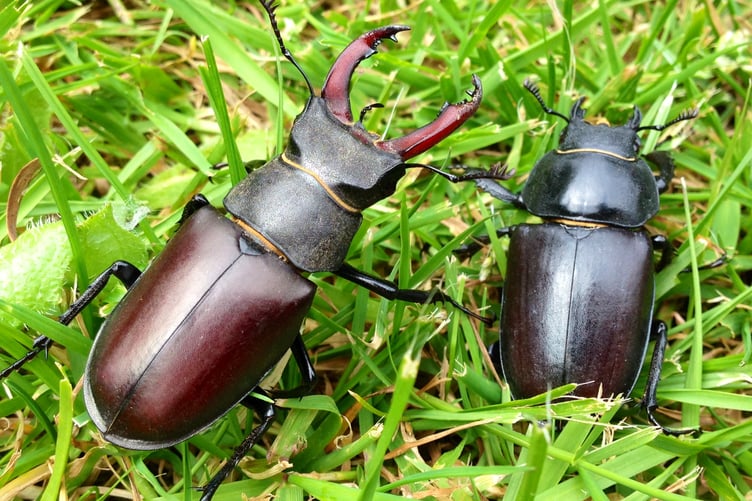
Males are instantly recognisable with their distinctive antler-like jaws and are often seen flying on warm, still evenings in summer, in search of females, which are slightly smaller and lack the impressive “antlers”.
David Wembridge, conservation research and strategy officer at PTES, said: “The extraordinary adult beetles that you might see in the summer are only half the story.
“The larvae, which develop into big, white grubs with orange heads, feed on rotting wood in the soil, often at the base of an old tree stump or fence post. They’ll grow, hidden away, for three to five years before emerging as adults in late May.
“It’s the loss of these deadwood habitats that we think might be impacting stag beetle numbers, and why it’s so important to retain or create these sorts of habitat in gardens.”
Conservationists hope it may be possible one day to monitor stag beetles acoustically by using software to recognise their characteristic “thrumming” sound in flight.
However, PTES needs lots of video and audio data first to explore whether this is possible. Every contribution from the public is important –visual, audio, or video – and it’s simple to take part.
Keep an eye out for stag beetles on warm evenings and report sightings online at ptes.org/gsh. PTES has online ID guides to help you identify a stag beetle from similar insects.
You can also upload images, video and sound files. Whether you’re walking the dog, commuting, doing the school run or heading to the pub, every recorded sighting is valuable.
The European stag beetle (to distinguish it from the smaller lesser stag beetle) is native to Britain, where its distribution has changed little over the past century.
However, the long-running survey has found that sites where the beetle is found are becoming scarcer in some areas and that numbers of beetles, too, may be declining.
Data from The Great Stag Hunt are vital for conservationists to track these changes, particularly in the current climate crisis.
Comments
We've recently changed our login process. If you have an account for commenting, you will need to re-register on the login window.
This article has no comments yet. Be the first to leave a comment.