
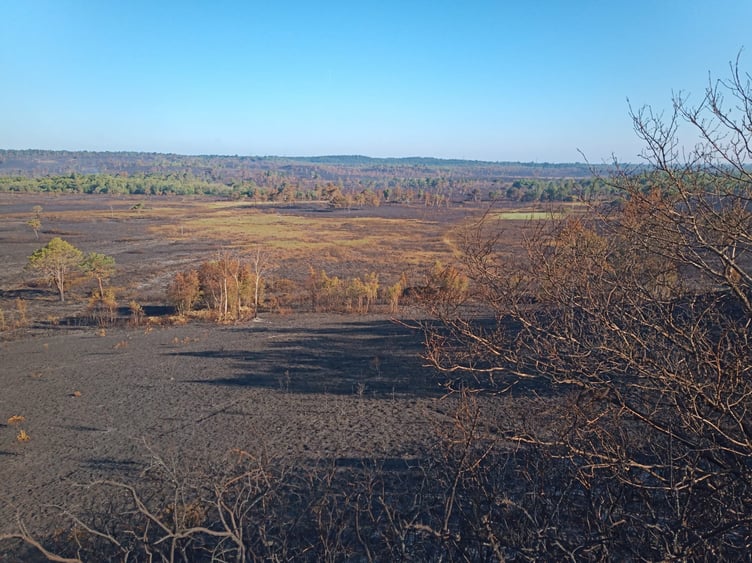
.jpeg?trim=33,0,34,0&width=752&height=501&crop=752:501)
This has been a bad year for countryside wildfires, exacerbated by a heatwaves and a long dry period.
The number of wildfires reported so far this year in England and Wales is 1017 as I write: already matching the number for the whole of 2025.
Locally, there have been wildfires on numerous open spaces including Blackheath and Whitmore Commons, Brentmoor Heath and the Riverside Park Nature Reserve in Guildford.
The precious lowland heathland in our area is tinder dry and especially vulnerable. They are part of the Thames Basin Heaths, a rare and threatened habitat that includes the Chobham Common National Nature Reserve and several designated as Special Protection Areas and Special Areas of Conservation, all home to a unique variety of wildlife.
Wildfires can completely destroy large areas of heathland, injuring or killing wildlife and ruining the environment for visitors. They also stretch the emergency services to their limit. Habitat recovery can take many years.
Further afield, there have been numerous fires on the heathlands of the New Forest – sometimes several in a single day – including the major wildfire that firefighters have been battling against after several days (as I write).
Some campaigners blame the record-breaking number of wildfires on the Government’s environmental policies which involve allowing nature to develop without human interference – policies they say make it harder for land managers to carry out controlled burning of heather and grasses during the cooler months, said to be necessary to create the firebreaks necessary to stop wildfires spreading in warmer months.



The most vocal complainants, it must be said, represent organisations preserving upland moorland used for sheep grazing and grouse shooting. They argue the policy has contributed to a build-up of vegetation that can act as fuel during heatwaves.
The Countryside Alliance said: "Moorland communities are facing increasing challenges, the Government having recently more than trebled the area over which the controlled burning of vegetation is effectively banned in our uplands. Government has in effect banned the single-most important method of preventing wildfires."
Lord Botham, a prominent critic of rewilding, said: "The winter burns used to create firebreaks. The new winter burning season is due to start on October 1. The Prime Minister has only weeks to get preventative winter burns restarted."
Locally, Surrey Wildlife Trust has an agenda that aims to protect habitats and wildlife, not commercial interests. Oliver Fry of SWT told me its approaches the problem on the reserves it manages without recourse to winter burning.
He said: “Generally speaking, nowadays SWT creates firebreaks – an essential aspect of modern day heathland management – using manual and mechanical methods to create paths and other areas of bare ground which can stop the spread of fires.”
Oliver added that the trust also adopts other practices. “Conservation grazing using cows and sheep, alongside scything by hand, maintains sward at healthy levels and prevents the build-up of scrub. The trust maintains that a healthy approach to rewilding will always incorporate steps to minimise the risk of fires, including by creating more wetland areas, ponds and ditches which also act as vital defences against flooding while providing vital habitats for nature.”
We must play our part in the countryside too: don’t light a fire or barbecue – pack a picnic; be sure to extinguish cigarettes; take rubbish home, especially glass that can magnify the sun’s rays and start a fire. If you see a fire anywhere call 999 and give an accurate location: apps like what3words can help firefighters find a fire quickly.
Be careful and be safe!
Comments
We've recently changed our login process. If you have an account for commenting, you will need to re-register on the login window.
This article has no comments yet. Be the first to leave a comment.