
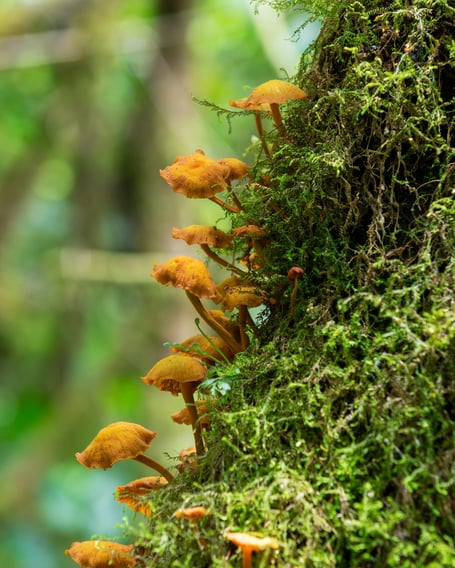

Why did the mushroom go to the party? Because he’s a fungi! (Mushroom jokes are terrible, but they grow on you!)
Why mushrooms? Well, the Royal Horticultural Society (RHS) has just forecast that mushroom (fungi) sightings this autumn could exceed last year’s record. It says that, after the exceptionally hot and dry summer, fungi in gardens will flourish when wet weather returns, provided there is sufficient rainfall.
It says that, at RHS Garden Wisley, early sightings of large rooting boletes (a diverse group of mushrooms) as well as giant funnel mushrooms suggest many species are poised to fruit prolifically.
As moisture returns to the soil, conditions are in place for one of the most spectacular displays of fungal fruiting bodies in recent years, including species such as fly agaric, giant puffballs and upright coral.
Jassy Drakulic, RHS senior plant pathologist, said: “Gardeners may notice a remarkable variety of mushrooms and toadstools appearing in lawns, borders and around trees this autumn. While gardeners sometimes worry at the sight of mushrooms, the presence of fungi is mostly a sign of a healthy ecosystem.
“These fruiting bodies are just the visible part of extensive fungal networks beneath the ground or within wood, where they play vital roles in recycling organic matter, supporting plant health and helping nutrients move through the ecosystem.”
Most garden fungi are beneficial and play essential roles in soil health, but a few can cause problems. The fungus most frequently reported to the RHS advice team is honey fungus, a pathogen of woody shrubs and trees.




Scientists at RHS Wisley are currently running a trial in which a bed of hydrangeas badly affected by honey fungus root rot is being inoculated with sulphur tuft – a beneficial fungus – to test whether it can out-compete the pathogen.
While this is the first time the approach has been tested in a garden bed, lab-based studies have shown that sulphur tuft can out-compete honey fungus, providing early evidence that it may help reduce the disease.
Drought affects both the habitat and food sources of fungi and these changes prompt many garden fungi to reproduce. For example, fungi that feed on decaying organic matter take advantage of the additional dead plant material resulting from drought.
Similarly, fungi feeding on heartwood decay can flourish in drought years as more dead wood forms inside standing trees. Meanwhile, mycorrhizal fungi may receive stress signals from their partner trees which lead them to invest in reproduction, in order to start a new generation in a more favourable location.
Fancy encouraging beneficial fungi? The RHS has these top tips for encouraging them in gardens of all sizes:
Mulch regularly with organic matter - apply wood chip, leaf mould or garden compost to feed soil organisms and create favourable conditions for beneficial fungi.
Keep some dead wood in the garden - log piles, stumps and decaying branches support a wide range of fungi that recycle nutrients and enhance biodiversity.
Leave autumn leaves where they fall - leaf litter provides food and habitat for many fungi and helps build healthy soils.
Let soil fungi establish naturally - dig less and avoid fungicides and synthetic fertilisers.
Be curious - as no UK fungi can harm through touch alone, it’s safe to get close to appreciate their unique forms and familiarise yourself with them.
That’s all this week – I must hasten away, which reminds me: What do you call a mushroom in a hurry? A rush room! (Sorry, I’ll let myself out.)
Comments
We've recently changed our login process. If you have an account for commenting, you will need to re-register on the login window.
This article has no comments yet. Be the first to leave a comment.