
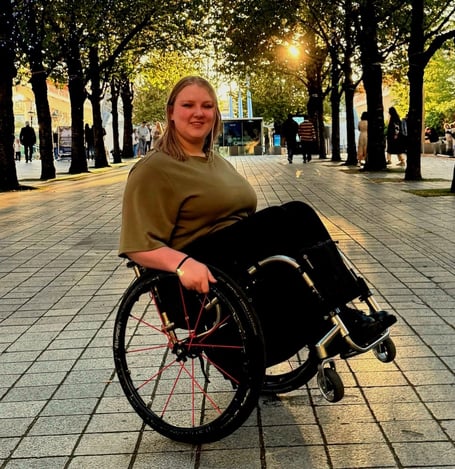
Lauren Wyatt has Tourette syndrome and wants more people to understand what this means.
The 23-year-old from Woking is taking part in the Tourettes Action's #NoChoice campaign, a nationwide call to challenge assumptions and encourage understanding for the 300,000 plus people in the UK living with Tourette syndrome.
The message is: Tourette syndrome is not a choice – how people respond is.
Despite affecting an estimated 1 in 100 school-aged children, Tourette syndrome remains widely misunderstood.




People living with Tourette syndrome often face judgment, isolation, and stigma because of involuntary tics.
The #NoChoice campaign aims to challenge these misconceptions and shift public attitudes from assumption to understanding, through a series of films, posters and digital content featuring people with Tourette syndrome in everyday situations where they are often misunderstood.
“I am thrilled to be a part of Tourettes Action's #NoChoice campaign,” said Lauren.
“I have Tourette’s, and I feel that it is one of the most misunderstood conditions out there. So many people have heard of it, but so few actually have any idea what it is really like to live with.
“I have damaged my body beyond repair and live in constant pain due to my tics, and I'd still say that the most difficult part to live with is the public perception and reaction.
“I experience harassment almost every time I leave my house, whether that is people mimicking my tics, threatening to hurt me, or sometimes even throwing things at me – all because of something that is out of my control.
“So many of these people don't understand that I have no choice in my tics, and they aren’t interested in learning when I try to explain.
“I really hope that this campaign will open people's eyes to the reality of TS, and help them realise that I, and so many others with Tourette’s, would never choose to live with this condition, and would never voluntarily act this way.”
Lauren has been to the USA to represent the Tourette Association of America as a Rising Leader to meet state representatives to talk about congressional changes needed to help support people with Tourette Syndrome.
Emma McNally, CEO of Tourettes Action, added: “People with Tourette’s don’t choose their tics but society can choose how they respond.
“Small moments matter, whether it’s a look, a comment, or a reaction.
“We understand that initial reactions can sometimes be surprise or uncertainty, but it is what follows that makes the difference.
“Do people respond with empathy and kindness, or with judgement? Tics are not deliberate, not behavioural, and not something that can simply be switched off. People’s reactions to tics can make a huge difference.
“While many people have now heard of Tourette syndrome, the reality is that very few truly understand it.
“Films like I Swear have opened people’s eyes to how people with Tourette’s were treated in the past, and many were shocked by what they saw.
“But the truth is these experiences are not just history, they are still happening today.”
Comments
We've recently changed our login process. If you have an account for commenting, you will need to re-register on the login window.
This article has no comments yet. Be the first to leave a comment.