
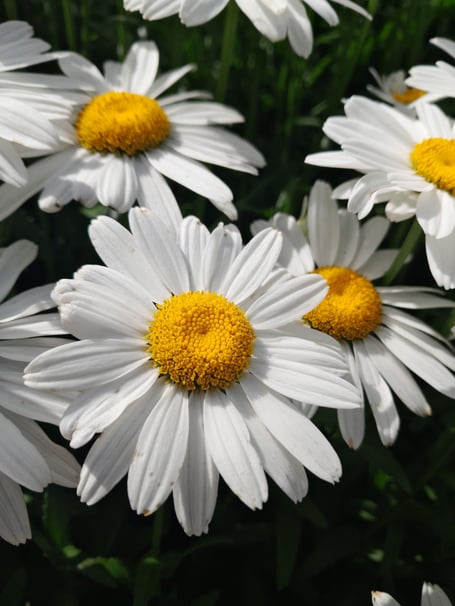
“He loves me, he loves me not!” The petal-plucking game has been popular with children for generations. It’s said to tell the player if their sweetheart truly loves them or not.
Just in case you’ve not heard of it, children pluck off flower petals in turn, alternately saying “He loves me,” and “He loves me not” (or “She loves me,” and “She loves me not”) Whichever is spoken when the final petal is pulled is said to be “true”. The suspense increases as the final petal approaches!
The consensus is that the game was originally played with an ox-eye daisy, rather than with the smaller common daisy (also called a lawn daisy or an English daisy) we usually use today.
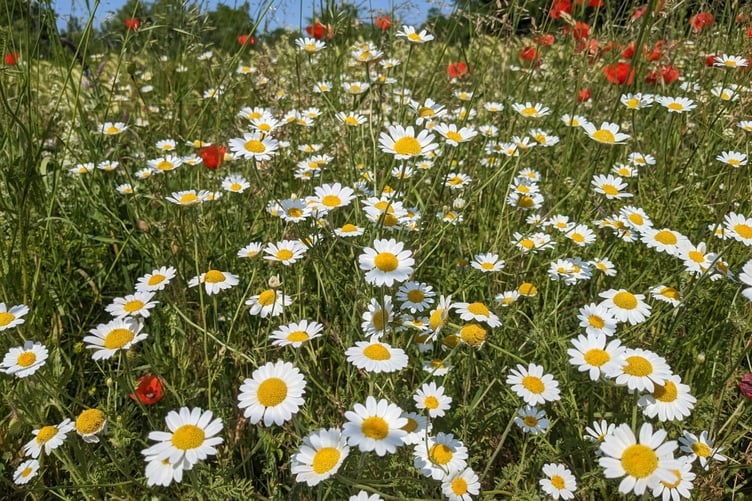
According to Wikipedia, the game originated in France. In the original version, petals of the ox-eye daisy were plucked not simply to indicate whether the object of the player's affection loves them or not, but to show the extent of their love: un peu (a little), beaucoup (a lot), passionnément (passionately), à la folie (to madness), or pas du tout (not at all).
That’s enough of the lovey-dovey stuff – now let’s introduce the ox-eye daisy properly!
It is a common flowering plant with large, round flower heads (white petals around yellow florets) which appear on single, tall stems. It has spoon-shaped leaves at its base and thin, jagged leaves along the stem.
Ox-eye daisy is sometimes spelt without the hyphen as oxeye daisy. It’s also known as the dog daisy, field daisy or Marguerite.
It is found in traditional hay meadows, on roadside verges, field boundaries and waste ground.
Its large blooms appear from July to September and, according to The Wildlife Trusts, are so bright they appear to glow in the evening, giving rise to its other common names of “moon daisy” and “moonpenny”.

-(Photo-by-Gerry-Smeesters).jpeg?width=209&height=140&crop=209:145,smart&quality=75)
The same source also tells that each of a flower’s petals is actually an individual flower, as oxeye daisies have composite flower heads consisting of yellow “disc florets”, surrounded by “ray florets” (the “'petals”).
The ox-eye daisy is tough: I recall they were prolific where I grew up on a new-build housing estate. We sometimes played among houses still under construction, even climbing staircases to explore upstairs. I don’t recall doing anything I felt was dangerous! I’ve no doubt that today such sites are fenced off to keep children out.
All around the site, ox-eye daisies thrived stubbornly on piles of discarded earth, on and among patches of rubble and alongside new brick walls on the hard, dry clay soil. On reflection, the building work was on former farmland that included hay meadows, so the plant’s abundance should not be surprising.
The ox-eye daisy spreads by seeds and by shallow, creeping underground rhizomes. A single plant can produce up to 26,000 seeds which are spread by animals, vehicles, water and contaminated agricultural produce. Seeds can be viable for up to forty years.
The ox-eye daisy is unpopular with farmers: a new plant can regenerate from rhizome fragments, so can be difficult to control or eradicate. It’s a problem in pastures where beef and dairy cattle graze: they do not usually eat it, enabling it to spread. If a cow should digest it, the milk will have an undesirable flavour.
All good reasons why – to borrow from the children’s game I started with – farmers “love it not”!
Comments
This article has no comments yet. Be the first to leave a comment.