
.jpeg?trim=0,0,3,0&width=752&height=500&crop=752:500)
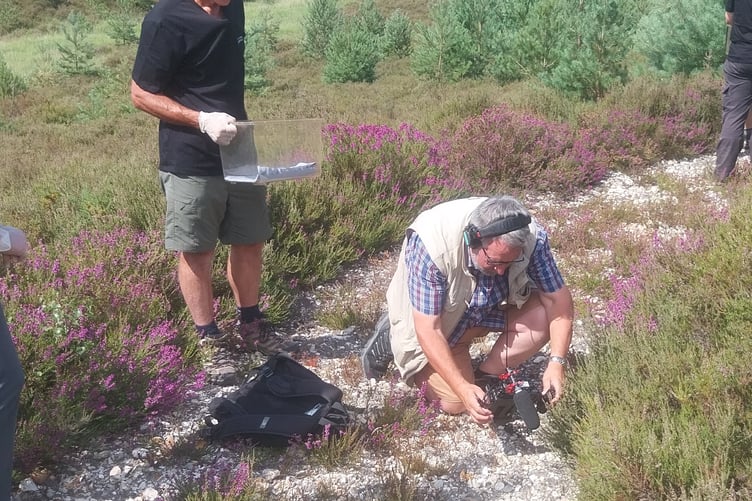
Sand lizards were reintroduced this summer to the fire-damaged heathland of Ash Ranges. A conservation charity, Amphibian and Reptile Conservation (ARC), bred eight of the reptiles in captivity and has released them on the Ranges, located to the west of Pirbright.
Chris Dresh of ARC said: “The sand lizard is an attractive, highly patterned lizard, larger than the more widely distributed common lizard. It is our rarest and most impressive lizard. The males have a bright green colouration during the springtime breeding season.
“The sand lizard is confined to sandy habitats as it buries its eggs in sand exposed to the sun so that they incubate successfully. The extensive heathland of Ash Ranges – nearly 1,400 hectares in size – is ideal.”
Ash Ranges is owned by the Ministry of Defence and used as a live firing range with limited public access. It is designated as a Site of Special Scientific Interest (SSSI) for its lowland heath, wet heath, bog and acid grassland habitats.
The Ranges is also an important part of the Thames Basin Heaths Special Protection Area (SPA) and forms part of a Special Area of Conservation extending over the larger blocks of heathland in Surrey because of the rarity of heathland both in the UK and internationally.
The site is jointly managed for its wildlife interests by Surrey Wildlife Trust (SWT) and the Defence Infrastructure Organisation (DIO).
ARC has had a long interest in Ash Ranges and works in close partnership with SWT to look after the extremely important reptile populations alongside the equally important bird and invertebrate populations.
.jpeg?width=209&height=140&crop=209:145,smart&quality=75)



Rob Free, ARC Weald reserves manager, told me: “Sand lizards may have died out on the Ranges due to various factors including wildfires and the scrubbing over of heathland. ARC has been involved there since the early 1980s, gradually returning a 70-hectare section in its care from scrub, bracken and young secondary woodland back to lowland heath supporting some of our rarest wildlife species.
“In the 1970s their population in the southeast had declined to such an extent that they could only be found on a handful of sites within a mile or so of Tilford village, with a population numbered in the hundreds.
“From 1994 sand lizards were released onto ARC’s managed area at Ash Ranges and the population began to flourish and spread.
“They thrived there until a massive fire in 2015 which effectively destroyed the population and the habitat that supported it.
“Now, after 10 years, the habitat has recovered under SWT’s management to an extent that it can provide both sufficient invertebrate food and shelter for sand lizards.
“We have therefore begun a programmed release, working in partnership with SWT, under a Natural England licence.”
The sand lizards released this summer are the first of many that will be released over a three-year period in the hope that a thriving population can again be established.
Chris Dresh added: “It’s just one element of a broader conservation strategy by Surrey Wildlife Trust: a great mix of traditional techniques for specific species, coupled with a broader rewilding strategy which involves the use of grazing animals to help keep scrub under control and created a mix of different ages of heather cover as this variety helps a wide range of species.
“Wildfires remain a concern, particularly in these times of climate change, but SWT is in the process of producing a wildfire management plan to guide how best to protect this important yet highly vulnerable habitat in the future.”
Comments
We've recently changed our login process. If you have an account for commenting, you will need to re-register on the login window.
This article has no comments yet. Be the first to leave a comment.