
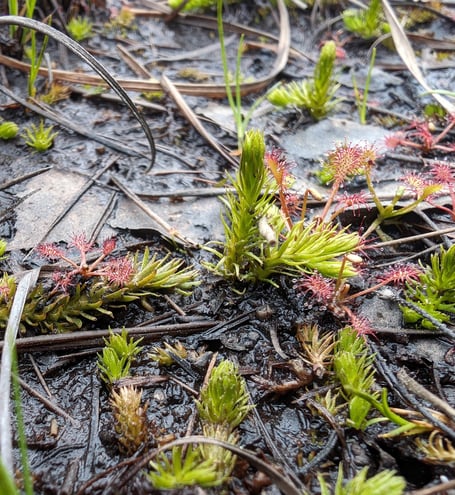
A rare plant often described as a “living fossil” was discovered last year on Pirbright Ranges during a heathland survey by Species Recovery Trust with Surrey Wildlife Trust which manages the land.



Few will have heard of marsh clubmoss, but it first appeared on the planet 400 million years ago, thriving during the Silurian and Carboniferous eras. It is virtually unchanged from the plants our vertebrate ancestors would have seen when they first emerged from the oceans!
Despite its name, marsh clubmoss is not a true moss but a primitive non-flowering plant more closely related to ferns. Botanists say it is a pteridophyte (a group including the ferns, horsetails and other clubmosses).
It mainly lives on wet areas of heathlands, particularly where there is disturbed, bare ground. It has the ability to blend in amongst sphagnum mosses and heather.
Water levels must remain just below the surface of the soil in the summer months. Marsh clubmoss cannot survive permanently in water but equally it cannot survive where the soil dries out completely.
The species was once widespread across the extensive heathlands and wet mires in the UK; but as these habitats were destroyed over the last two centuries these populations became more fragmented and eventually most were wiped out.
Globally it is very rare, and critically the UK holds a substantial proportion of the global population, due to the massive decline in the grazed wet heathland habitats favoured by marsh clubmoss throughout its north-west European range. It’s thought to be present at just under 70 heathland locations.
It has been found on a small number of Thames Basin Heaths, including Pirbright Ranges, and also has strongholds in the New Forest and Dorset.
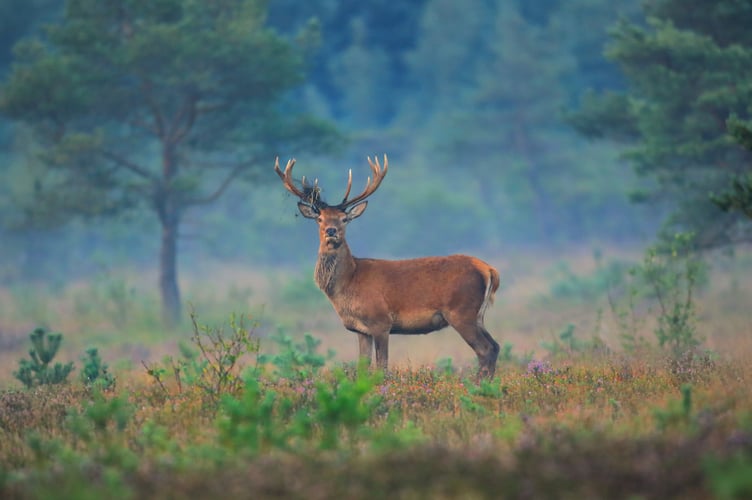
At Pirbright Ranges it has been found growing along channels of bare ground created by the of grazing of Surrey Wildlife Trust’s herd of red deer, which perform a vital role by grazing the heathland to prevent scrub including Scots pine, common gorse and silver birch from taking over the site.
This in turn allows slower-growing dwarf scrub and specialist heathland plant species to flourish.
In July 2022 Pirbright Ranges suffered an extensive wildfire covering some 650ha of the reserve. Surrey Wildlife Trust said at the time that it was expected to take over a decade for the site to recover to its former condition.
However, 8,400 of the marsh clubmoss plants were identified in just one area of the ranges during Surrey Wildlife Trust’s survey last year with the Species Recovery Trust.
Surrey Wildlife Trust said it demonstrates nature’s remarkable recovery, thanks in part to those who donated money to its wildfire appeal.
The Pirbight Ranges reserve is not accessible to the public, as it is adjacent to a live military firing range. However, if you are visiting other wet heathlands, you might spot marsh clubmoss growing on the margins of small pools, such as may form in depressions in trackways or sloping seepage mires – but always where there has been some disturbance, for instance due to grazing, movement of machinery.
It has a distinctive lime-green colour and looks like the young tips on the ends of spruce trees. It has creeping horizontal stems that grow to between 5-20cm in length and vertical spore-producing shoots, 5-8cm tall, which appear in late summer.
Plants grow and divide, and it is common to find plants in the process of sub-division.
Congratulations if you spot some of these “living fossils” during a heathland ramble!
Comments
We've recently changed our login process. If you have an account for commenting, you will need to re-register on the login window.
This article has no comments yet. Be the first to leave a comment.