
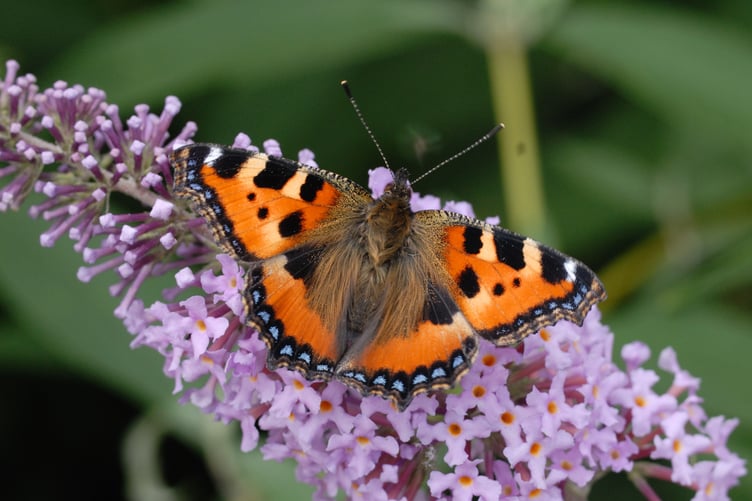
What is “top of the pops” with pollinators? It’s not buddleja, lavender or dandelion, as I suspected!
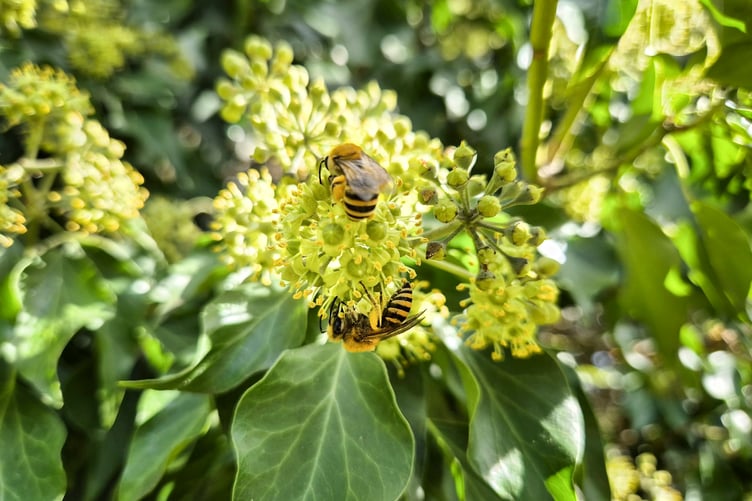
An eight-year study has revealed that ivy is the most popular flower with butterflies, bees and other pollinating insects.
Ivy’s popularity shouldn’t have surprised me because the ivy in my garden is always teeming with insects from late-September onwards, especially with ivy bees – a type of solitary bee that nests in holes in the ground.
The study results were announced since I wrote about both the ivy bee and the ivy shrub, which is a source of pollen and nectar to many winged insects in late-summer and autumn, when most plants have finished flowering.
(My article was in the issue dated 1 October and can be read on our web site at https://tinyurl.com/ivy-bees).
Ivy may be unpopular with some gardeners, but the climbing vine’s abundant late-summer and autumn blooms received the highest average number of insect visits out of 14 common and widespread flowers surveyed during 10-minute counts by “citizen scientists” across the UK.
Ivy recorded an average of 22 insect visits per 10-minute count, followed by hogweed (20 visits). In joint third place were bramble, buddleja, knapweeds and thistle, each scoring an average of 14 insect visits per 10-minute count.

The floral facts have been revealed by the UK Pollinator Monitoring Scheme (PoMS), which has asked citizen scientists to record insect visits to flowers since 2017.
The scheme recommends a list of 14 target flowers to monitor (including ivy), but counts can be carried out on any patch of flowers in gardens or the countryside.
The scheme is run by the UK Centre for Ecology & Hydrology (UKCEH) and the Joint Nature Conservation Committee (JNCC) with support from Butterfly Conservation and other partners.
Butterfly Conservation Butterfly Monitoring Officer Jo Milborrow said: "These results are fantastic because they provide valuable information about pollinators' favourite flowers, helping people all over the country take action at home to support butterflies, moths and other insects.
"We already recommend ivy as a great plant to grow because it is an important resource for breeding holly blue butterflies and nectaring commas and red admirals, so the fact that this easy-to-grow native species is also the number one plant for pollinating insect visits is a fantastic discovery – we would recommend people to start growing ivy today!"
The latest annual report from PoMS revealed that hoverflies declined by around a third in both their abundance and number of species recorded across GB in all three surveys conducted over the past eight years.
The total numbers of all insects, and of bumblebees, also declined in two of the three PoMS surveys, signalling possible risks to the health of our ecosystems.
In contrast, the abundance and number of species of solitary bees increased in one survey but did not change in the other two. Honeybees, other (non-hoverfly) flies and beetles all increased in the survey covering mostly gardens, suggesting that these could be providing an important refuge for some of our pollinators.
Perhaps you’d like to take part in the UK PoMS survey next year. You just need to spend 10 minutes watching flowers and insects in good weather and count the total number of insects that visit a particular flower, ideally chosen from the PoMS list of 14 target flowers.
Counts can be done anywhere, including gardens and parks, in warm, dry weather during daylight hours from 1 April to 30 September.
For full details visit ukpoms.org.uk
Comments
We've recently changed our login process. If you have an account for commenting, you will need to re-register on the login window.
This article has no comments yet. Be the first to leave a comment.