
.jpeg?trim=0,0,3,0&width=752&height=562&crop=752:562)
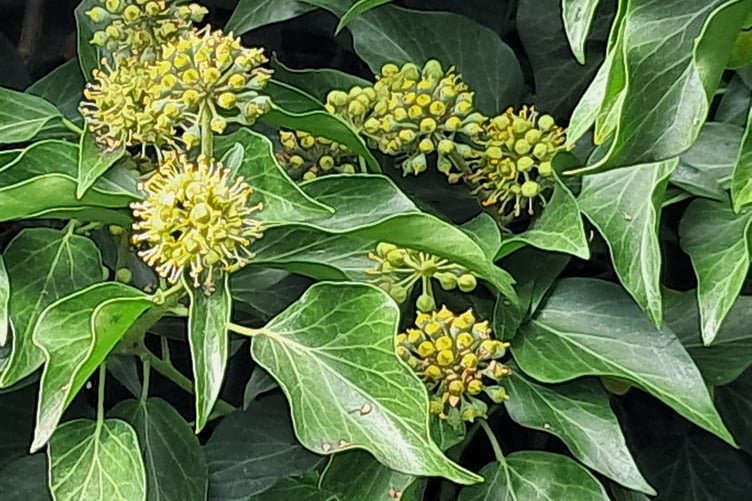
It’s ivy bee time! As I write, dozens of these insects are busily collecting nectar from a mass of ivy flowers on a plant rooted on my neighbour’s side and growing through into my garden.
Ivy may be unpopular with many gardeners, but is it is a valuable source of pollen and nectar to many winged insects when most plants have finished flowering – and especially to ivy bees, which are relative newcomers to the UK.
This bee was first spotted in the UK in 2001, in Dorset, and has been extending its range ever since. They are now common throughout southern England and have been recorded in both Wales and North East England as far as County Durham. They are found in a variety of habitats, including coastal and urban locations.
They are slightly larger than honey bees, with a ginger thorax (the part behind the head) and an orange/yellow striped abdomen. They also have a distinctive yellowy-orange tuft on top of their heads.
Ivy bees take to the wing in autumn, coinciding with the flowering of ivy, which, as their name suggests, is their main food resource, although they have been seen feeding on other plants including chicory, dandelions and plants of the daisy family.
Because of the importance and flowering period of ivy, it’s possible to see this species from September into October, even through November.
The ivy bee is solitary – it does not live in social groups, like honey bees, but singly, nesting in a hole in the ground. They prefer loose, sandy soil, with ivy nearby for foraging. Although solitary bees, there may be thousands of nests in the same area if conditions are suitable.




These large nesting groups mainly occur on south-facing slopes with sparse vegetation and bare earth cliffs, as well as in garden lawns, parks and the wider countryside.
Each female ivy bee excavates her own nest hole, using her saliva to smooth over and firm up the walls. Into this she lays eggs together with pollen and juicy nectar, which will provide food for the bee larvae that hatch.
She then seals off the hole and starts on another chamber. Nest burrows may be reused, and the burrows may measure up to almost half a metre in depth.
They are annual bees, so the adults do not survive into the following year. The bees you see this autumn are from eggs laid the previous year.
Males emerge from nests when ivy begins to flower, from late-August and into September. Females emerge a few weeks later. If you are lucky enough to find nest burrows of the ivy bee, look out for clusters of mating bees as new females emerge from the burrows from mid-September onwards.
As females leave the nest, many males may pounce on her at the same time as they compete to mate!
If you discover ivy bees nesting in your lawn in large numbers, don’t worry about them and avoid mowing – they are harmless, not aggressive and will be around only for up to six weeks
Ivy bees are important late-season pollinators, and flowering ivy provides a particularly valuable source of both pollen and nectar for these bees – as well as hoverflies, other bees, wasps, butterflies and moths – when few other plants are in bloom.
Allowing ivy to flower and retaining patches of suitable bare ground are simple ways of helping this attractive and increasingly familiar autumn bee.
Comments
This article has no comments yet. Be the first to leave a comment.