
.jpeg?trim=134,0,46,0&width=752&height=500&crop=752:500)
.jpeg?width=752&height=500&crop=752:500)
The festive season coincides with the longest nights. It’s when we’re most likely to notice a curious phenomenon: our lights are a beacon for moths and other nocturnal insects.


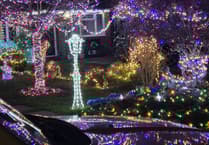

That they are attracted to light, from any source, is so familiar we have the saying “drawn like a moth to a flame”. But why do they do it?
There’s a posh name for this phenomenon: “positive phototaxis”. But as yet there doesn’t appear to be a clear answer as to why insects seem to gravitate towards sources of light.
One theory I’ve heard many times is that artificial lights confuse moths that are using the moon and stars to navigate, but that has fallen out of favour.
Recent studies of certain moth species in Australia showed they use the stars for long-distance annual migrations. However, while human lights might disrupt moth navigation, it doesn’t explain the short-range attraction that moths and other insects demonstrate.
Another unproven theory is that moths use light as a means to escape predators: in settings without artificial light, areas of natural light would usually indicate an open space or gap in foliage which could help moths escape.
Recent examinations of insects’ behaviours by scientists have resulted in a new theory: moths become “trapped” when they encounter an artificial light source, leading to them circling around the light or repeatedly crashing. The scientists propose that moths use light as an orientation cue, to help tell which way is “up” when flying in the dark.
In the natural world, the sky is always lighter than the ground. So by positioning their backs towards the brightest part of the night-time environment, moths can remain the right way up. But when they encounter light from artificial sources, moths readjust their orientation to keep their backs facing the light.
This can result in circling behaviour as the insect tilts its body toward the light or, if it has approached from below the light source, causing it to flip upside down to keep its back facing the light, leading the moth to stall and fall to the ground.
Artificial light has an important role in the study and therefore conservation of moths. Light trapping, where lights are attached to a container to encourage moths to enter but not exit, allow conservationists to record numbers and types of moth species in a given area.
However, too much artificial light at night is a problem for the UK’s moths, says Butterfly Conservation, a charity dedicated to conserving and studying butterflies and moths.
It explains that moths drawn to artificial lights may spend time and energy travelling away from their chosen trajectory, and those becoming stuck circling lights also waste precious energy, leaving them too exhausted to find food or breed.
Moths visiting artificial lights are also more vulnerable to predators, some of which are known to hunt around lights.
Moth caterpillars are affected by artificial light, too. Experiments have shown that artificial light at night disrupts feeding and the development of caterpillars and pupae. These can contribute to reduced moth numbers: a study involving Butterfly Conservation found 47 per cent fewer moth caterpillars in hedgerows under streetlights.
However, the charity suggests how we can help them by making a “moon meadow”: a green space or planted area, such as a pot, filled with plants that benefit our night-time moths and other pollinators, with a secret ingredient – the moon!
To download their moon meadows guide visit butterfly-conservation.org/join-the-dark-side
Comments
This article has no comments yet. Be the first to leave a comment.