
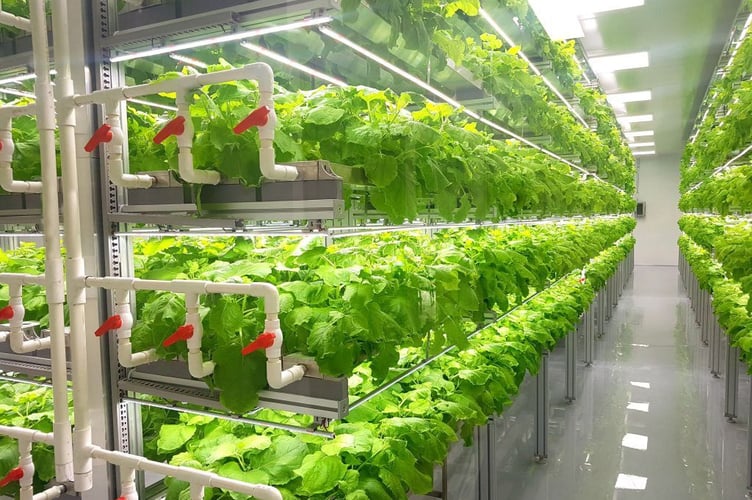
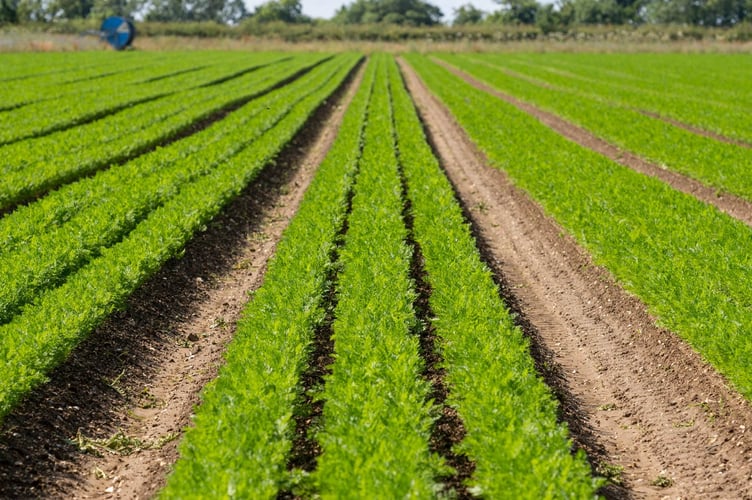
Were your supermarket salads grown indoors, without fertile soil, sunshine or rain? A system called vertical farming is increasing in popularity: lettuce, basil and other herbs are grown in vertically stacked layers, often under special lighting and in carefully controlled temperature and humidity conditions to maximise the harvest.



The main advantage of vertical farming is its huge increase in crop yield from per land area. And salads can be grown three times as fast as traditional outdoor agriculture thanks to the controlled, consistent climate.
In addition, being indoors, crops are resistant to weather disruptions, so fewer crops are lost to extreme or unexpected weather events. Vertical farming is also less disruptive to native flora and fauna.
Plants are often grown in such artificial environments without soil, their roots immersed in water-based mineral nutrient solutions – a system called hydroponics. Another method is aeroponics, where plants are suspended whilst their dangling roots and lower stems are sprayed with a nutrient-rich water solution.
Such modern farming practices usually take place within enclosed spaces above ground, but I recently saw in a TV documentary that salad plants are being grown in an abandoned tunnel under London, last used as an air raid shelter during the Second World War!
But there’s a downside, according to a new study led by the University of Surrey: it says that although vertical farming dramatically increases lettuce yields and uses far less water, the carbon footprint still exceeds traditional lettuce farming. Researchers say this raises important questions about how the UK can balance food security with environmental responsibility.
Their study analysed two UK farms – one on mineral soil, another on peat-based soil – and a farm in Spain, which together supply most of the UK’s lettuce. They then compared these with vertical farming.
It showed vertical farms can deliver over 20 times the yield of field farms –97 kilograms per square metre compared with just 3.3 kilograms. And water use is eight times lower than Spanish land farms, where irrigation demands are high.
However, greenhouse gas emissions are higher: even when powered by renewable electricity, vertically farmed lettuce produced 0.93 kilograms of greenhouse gases per kilogram grown, compared with 0.57 kilograms for UK field farms.
Much of the carbon impact was linked to the high energy demands of vertical systems, as well as providing jute fibre plugs – fibrous blocks made from jute stems that are used to support and grow the plants instead of soil.
Michael Gargaro, postgraduate research student at the University of Surrey, said: “Vertical farming has the potential to transform food security in the UK, particularly as climate change and seasonal drought place growing pressure on traditional agriculture. The challenge is to make vertical farming more energy-efficient and better integrated with renewable systems, so that it can become truly sustainable.”
Dr Zoe M Harris, director of the Centre for Environment and Sustainability at the University of Surrey, added: “With around 95 per cent of lettuce imported from Spain during the winter months, advances in vertical farming technology have made it possible to secure a year-round supply of fresh produce while freeing up land for restoration, such as peatland and woodland. But to viably compete with field farming, vertical farms must cut their energy use.”
I’ve no doubt the food scientists will overcome these hurdles, for these modern farming methods appear to me to be just what we’ll need to feed our growing population
Comments
This article has no comments yet. Be the first to leave a comment.