
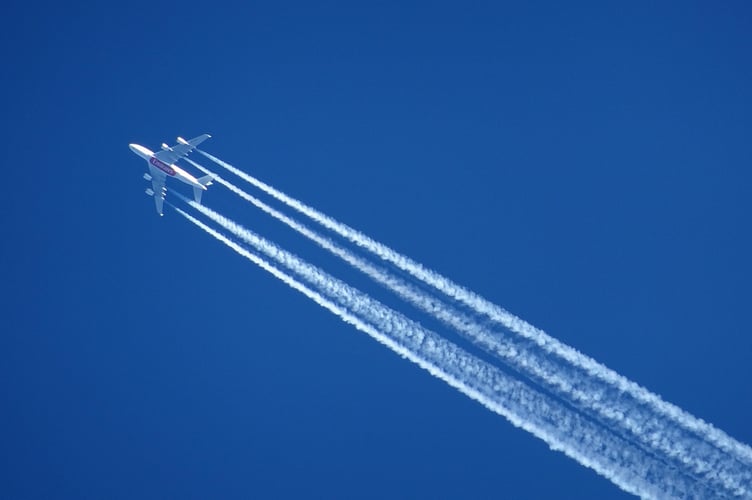




I’ve often gazed skywards and wondered whether vapour trails behind aircraft affect our climate.
These trails, known as contrails (short for “condensation trails”), are produced by the exhausts of an aircraft’s engines and are composed primarily of water, in the form of ice crystals.
They form as a plane cruises at a high altitude, usually above 8km (5 miles), where the air temperature is below −36.5C. They can also form closer to the ground if the air is cold. It is not smoke, as some may believe!
A jet engine’s exhaust is predominantly made up of water and carbon dioxide (CO2), which are the combustion products of hydrocarbon fuels.
The water leaves the engine as a hot vapour, which condenses into tiny water droplets on small particles that originate mainly from soot in a jet engine’s exhaust; these water droplets then freeze if the temperature is low enough.
These millions of tiny water droplets and/or ice crystals form the contrails. The exhaust also contains various other chemicals at much lower concentrations; these by-products are due to incomplete hydrocarbon fuel combustion.
Aviation currently contributes about 2.5 per cent of the global annual CO₂ emissions, primarily from the CO2 produced by burning hydrocarbon fuels. However, studies have shown that contrail clouds have a lesser but significant contribution to global warming.
Contrails have both warming and cooling effects: they trap infra-red radiation from the earth, which has a warming effect, while also scattering radiation from the sun, so less reaches the surface; this reduces the sun’s heating effect on Earth, which is cooling.
Contrails therefore have a much smaller warming impact in the daytime and may even have a net cooling effect. At night contrail clouds increase warming because they trap infra-red radiation that would otherwise pass into space.
The effect of contrails on climate is greatest in our summer, when the largest contrail cooling occurs. This is offset by the lower reduction in warming during spring and autumn when there are fewer contrails.
It appears the complex extent and effects of contrails on climate change have been poorly understood. I was interested therefore to read recently the results of detailed studies into the intricate and far-reaching “social” costs associated with aviation’s CO2 emissions and the less understood yet significant impact of contrail clouds.
The researchers aimed to develop an understanding of the total social cost of aviation by using data on flight routes, emission intensities, contrail formation probabilities, and regional climate sensitivities to produce a more comprehensive valuation.
One of the striking revelations from this research is variability in social costs. Areas under heavily trafficked flight paths, such as transatlantic corridors, bear disproportionately higher social costs due to persistent contrail formation, which raises regional warming effects.
They concluded that carbon pricing mechanisms for aviation need urgent recalibration to factor in the effects of contrails on climate change, which were previously neglected and underestimated.
This recalibration would translate to higher costs for airline emissions, prompting cleaner jet engine technologies and changes to aircraft operation changes, such as optimising flight altitudes and rerouting flights to avoid conditions that led to contrail formation.
As the world strives to contain warming below critical thresholds, acknowledging and addressing aviation’s climatic and social repercussions is essential.
The researcher’s hope their studies into the combined climate and economic impacts of both carbon dioxide emissions and contrail cirrus clouds will lead to more accurate accounting of the various effects of aviation on climate change.
Comments
This article has no comments yet. Be the first to leave a comment.