
.jpeg?width=752&height=500&crop=752:500)
Have you spotted many butterflies now spring has arrived, with gardens, hedgerows and green spaces bursting into life?



The appearance of butterflies, as overwintering adult butterflies become active, signifies the end of winter and a welcome start to spring.
Several people have recalled to me with excitement that they’ve see their first butterflies of the year – usually seen on recent sunny days.
My clearest butterfly high spot so far this year is of a sunny day towards the end of February when, during a lazy picnic in the heather gardens at RHS Wisley, I saw red admirals, brimstones and a solitary peacock butterfly.
Brimstones were the most plentiful. These are fairly large butterflies and obvious with their pale yellow or off-white wings fluttering across the sightline.
They have strongly-veined, leaf-shaped wings, which are clearly seen when they are at rest with their wings closed. The wings of males are lemon-yellow, while females are greenish-white with orange spots in the middle of each wing.
The red admiral is another large butterfly, very distinctive in its appearance thanks to broad red bars on its black wings, and white marks towards its wingtips. It is often spotted in gardens, feeding on buddleia and other flowers, but can be found in all types of habitat anywhere in Britain and Ireland.
Most of the red admiral butterflies we see in the UK have migrated here from North Africa and continental Europe, with the females laying eggs here that emerge as a new generation of butterflies from July onwards.
However, adults sometimes hibernate in the UK, so they may be seen flying on warm days throughout the year, although they are most common in the summer and early autumn.
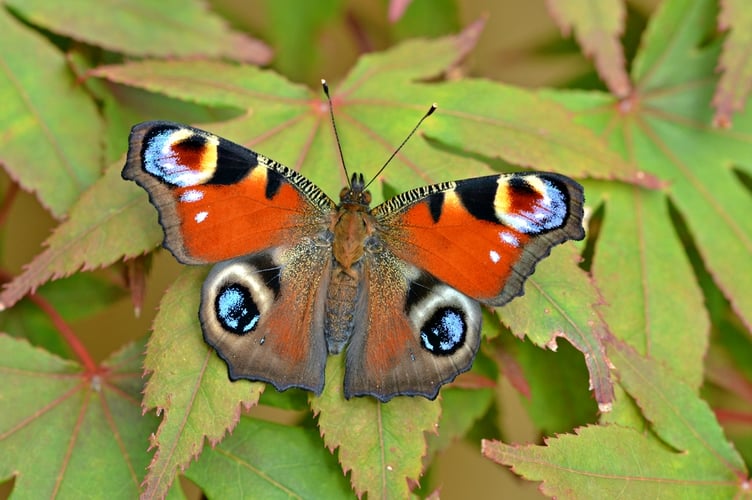
The peacock butterfly is probably our most familiar and unmistakable butterfly. Its (mainly) red wings that have big, blue “eyes” on the wingtips, similar to those on a peacock's tail feathers – which is of course how it got its name. The “eyes” have evolved to startle or confuse predators.
An interesting fact about the peacock butterfly is that it is able to make a hissing noise when alarmed, by rubbing its wings quickly together. This alarm sound together and those huge eyespots make the peacock a scary option to would-be predators!
The comma is another early butterfly, having several broods through the year and overwintering as an adult. It too is unmistakable: the ragged edges to its wings and orange and brown markings make it look like a dead leaf.
This means adult commas are concealed as they hibernate amongst dead leaves through the winter. Meanwhile the larvae, flecked with brown and white markings, look like bird droppings!
The comma gets its name from the comma-shaped white spots on the underneath of its wings. It is often seen in woodland.
The early thorn moth is another early spring species. Although common across Britain and Northern Ireland this brown moth is less often seen than the butterflies because it takes wing at dusk and into the night. The adult moths can often be seen at lighted windows and moth traps.
When at rest it holds its wings back and close together, similar to a butterfly, instead of opening them up in the usual moth fashion.
There are two distinct generations (except in the far north), each with a different appearance: the first flies in spring, then a second generation appears in late summer (August and September) which are usually smaller, paler moths.
That’s five species, each with peculiarities. Isn’t nature fascinating?
Comments
This article has no comments yet. Be the first to leave a comment.