
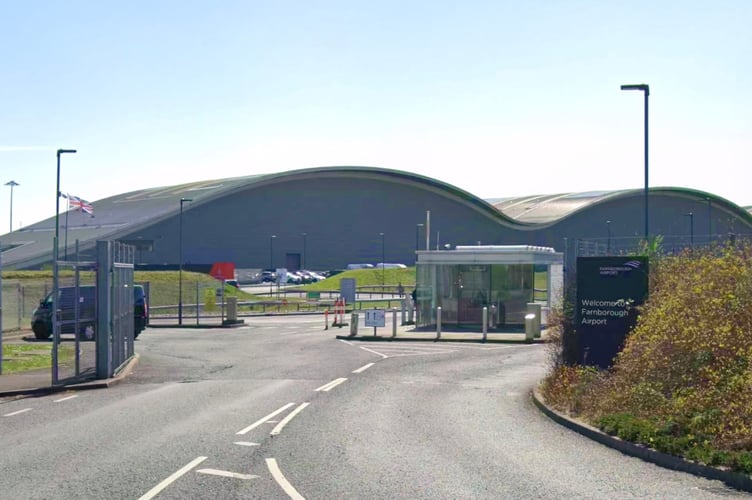
Farnborough Airport hopes to increase the number of weekend flights landing at the business hub to help meet it’s forecast demand, and neighbouring councils are being asked for their feedback.
A formal consultation from Rushmoor Borough Council has been submitted to Woking Borough Council to give views on the airport’s plan for a series of changes.
These include increasing the size of aeroplanes that are currently capped, more weekend flights, and new flight paths.
Waverley Borough Council has already said it opposes any such move with its members voting overwhelmingly against the expansion plans citing its likely impact on noise pollution, air quality, and carbon emissions.
-Westfield-FC-in-Woking-(image-Google).png?width=209&height=140&crop=209:145,smart&quality=75)


Farnborough is a business and private airport noted for being the first operational airfield in the country, dating to 1904.
It had been used for aviation research and development until being declared surplus to requirements by the Ministry of Defence in the 1990s.
Planning permission was granted in 2000 to change the use of the aerodrome for business aviation – with restrictions on the number of flights , 50,000 a year- as well as the days and times they could land.
There were also weight limits set for the planes.
Caps were imposed on weekend flights, in part, to give residents living nearby respite from the noise.
The airport is now looking to push those numbers and lift limits on restricted aircraft.
It wants to keep the total of 50,000 aircraft movements a year but increase the flights on weekends and bank holidays to 13,500, up from the existing 8,000.
It is also seeking to increase the number of larger aircraft landing at the airport.
Currently, only 270 of the 1,500 large jets can take off at weekends. It wants this to jump to 405.
Large jets are planes weighing between 50,000 and 80,000kg.
It wants to change this so that aircraft between 50,000 and 54,999kg are no longer part of the cap – if they are of the quieter, or more modern variety.
Flights take place 7am and 10pm Monday to Friday and between 8am to 8pm on weekends. It is currently closed on Christmas and Boxing Day.
The planning statement read: “ Aside from COVID-19 related disruptions, as seen in the drop in 2020, annual aircraft movements have grown from 25,500 in 2008 to 32,598 in 2022, with a slight reduction to 29,702 flights in 2024.
“It is clear that the pattern of operations and distribution of aircraft movements between weekdays and non-weekdays has remained consistent over time, with around 27 per cent of aircraft movement activity being on non-weekdays.”
It continues: “Forecasts for the future demand to use the airport have been prepared having regard to expectations for growth in business aviation demand to serve London and the surrounding areas in line with Government economic forecasts.
“A key consideration is the expectation that, over the next decade, there will be increasing displacement of business aviation activity from the main London airports so as to enable them to make best use of their runways for commercial passengers.
“Over the last decade, the airport has grown its share of the overall London market in part due to the quality of its facilities and in part due to displacement of activity from elsewhere.
“This trend is expected to accelerate as the larger business aviation airports increase their commercial operations, placing business aviation activity under increasing pressure.”
Comments
We've recently changed our login process. If you have an account for commenting, you will need to re-register on the login window.
This article has no comments yet. Be the first to leave a comment.