
-Katrina-Martin2020VISION.png?trim=517,0,518,0&width=752&height=501&crop=752:501)
There are footballers in Woking’s flower beds. And Chobham’s heathlands. And in trees across our beautiful county.
You’re probably thinking my brain is suffering overload from the blanket World Cup coverage. No, the footballers I refer to have never kicked a ball.
I’m referring to a common hoverfly helophilus pendulus, called the footballer after the black and yellow stripes on its thorax – that’s the central part of the insect – which are said to mimic football shirts.
However, it’s sometimes called the common tiger hoverfly or the sun fly due to its preference for bright sunny days.
The footballer is common across the UK in a wide variety of habitats, from woodlands to gardens to roadsides. It can often be seen visiting flowers on sunny days.
It is particularly fond of damp areas, as its young (larvae) live in shallow water with lots of rotting vegetation, or in very wet manure. The larvae are known as rat-tailed maggots because of their long “tail”, which is actually a breathing tube.




There are several similar stripey-bodied hoverflies related to the footballer, so it can be tricky to tell them apart. There’s a useful identification guide on the NatureSpot site naturespot.org/species/footballer.
The footballer is the most common of them, so is probably the one you're most likely to see.
Key features include a yellow face with a black stripe down the centre and the orange on its hind tibia (the middle section of its back leg). On the footballer, the top two thirds of the hind tibia are orange, with the bottom third black. Other similar species have more black.
Keep an eye out for footballers this summer – on and off the pitch!
Butterfly count
If you’ve seen enjoyed seeing butterflies recently you should get involved in Butterfly Conservation’s Big Butterfly Count. It starts tomorrow, Friday 17 July, and runs until 9 August.
Whether you do it on your own or as a family or with friends, it’s a great way connect with nature while providing vital data for conservation scientists.
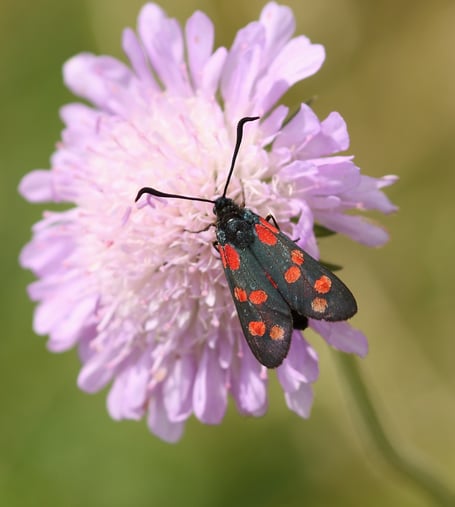
Just spend 15 minutes outside in a sunny spot, perhaps a garden, park, field, forest or allotment, and count the number of each type of butterflies (and some day-flying moths) you spot. Will you spot the peacock, voted Britain’s favourite butterfly in Butterfly Conservation’s recent poll?
You can enter your results either on the special website: bigbutterflycount.butterfly-conservation.org or by using the free Big Butterfly Count app for smartphones which enables you to count them on the move and submit your results all in one go.
You can repeat the count on as many occasions and in as many locations as you wish. Butterfly Conservation asks you to enter a result even if you don’t see any butterflies, so they know where butterflies are not being seen, which may indicate a problem.
Butterfly Conservation provides a list of target butterfly and moth species they would like counted. It explains that restricting the list reduces counting errors so they have a clearer view of actual butterfly numbers across the country.
The website and app provide lots of help to get you started.
The results enable scientists to see which species are faring well and which are in decline, which also reveals how climate change is affecting their habitats.
We must never forget that butterflies and moths are vital parts of the ecosystem, both as pollinators and as food for other creatures.
Comments
We've recently changed our login process. If you have an account for commenting, you will need to re-register on the login window.
This article has no comments yet. Be the first to leave a comment.