
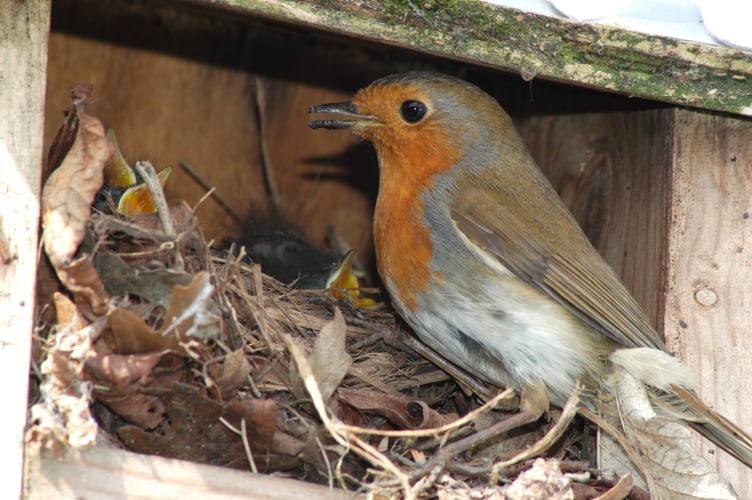
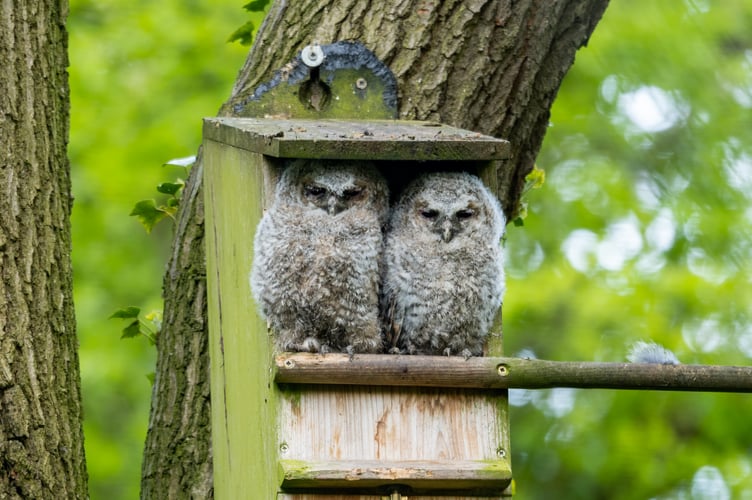
The nations’ wild birds were oblivious to humans’ romantic shenanigans last week on Valentine’s Day and the torrents of lovey-dovey marketing that accompanied it, yet many feathered garden friends were nonetheless busy making amorous plans: mid-February is when they start to pair up and seek out suitable sites for the coming breeding season.
Appropriately, Valentine’s Day marked the start of National Nest Box Week which is a great time to put up new nest boxes, says the British Trust for Ornithology (BTO).
Our gardens, yards and public green spaces can provide a perfect home for our most familiar and much-loved birds, such as the blue tit, house sparrow, starling and robin.
While many of these may find a safe place to nest in trees, bushes and other planted areas, or in and around buildings, there’s still a shortage of desirable nesting spots, particularly in more urban and suburban areas.
Several factors have reduced nesting opportunities for many of the UK’s breeding birds, including the loss of appropriate habitats through changes in land-use and “tidier” gardens.
It’s important therefore that we try to provide a haven where they can raise their broods. By providing nest boxes, we can easily help our garden visitors thrive.
Whether you buy a ready-made nest box or build one from scratch, consider which birds you might hope to attract. From great tits and starlings to tawny owls and stock doves, there are box designs to suit a wide range of species, with different needs.




By keeping note of the local birds that you see, you will be able to determine which species are most likely to nest there. Larger gardens can attract a wider range of birds, while smaller spaces may provide opportunities for fewer, but equally needy, species.
As when choosing our own homes, location is a critical feature when it comes to nest boxes. In most cases, they should be located between 1–3 metres off the ground, away from any bird feeders, and where the entrance is sheltered from prevailing wind, rain, and strong sunlight.
Some species such as the house sparrow and house martin, which have declined significantly in many parts of the UK in recent decades, choose boxes close to one another; other birds such as robins and blue tits are highly territorial and prefer their own space.
The swift also takes to artificial nesting sites. These amazing aerial acrobats, which migrate from Africa to nest in our towns and cities, have declined 70 per cent since the mid-1990s.
Swifts usually prefer to nest under the eaves of older buildings but modern household improvements and refurbishments have resulted in a reduction in suitable nesting sites.
Many homeowners provide special boxes for these visitors, whose distinctive screaming calls were once a familiar summer sound throughout the UK.
The BTO has a dedicated page providing information and advice on building, buying, and positioning nest boxes and the birds they can attract: visit www.bto.org/nest-boxes for details.
Nest boxes can also help supply important scientific data. BTO Nesting Neighbours survey organiser Hazel McCambridge said: “You can contribute vital data by recording the activity you observe, such as nesting behaviour, egg counts and fledgling success, which helps us build a picture of what is affecting bird populations.”
The BTO has thousands of nest boxes reported to its Nesting Neighbours scheme every year, and hundreds of people share observations from nest box cameras.
Visit www.bto.org/nest-monitoring for information.
Comments
We've recently changed our login process. If you have an account for commenting, you will need to re-register on the login window.
This article has no comments yet. Be the first to leave a comment.