
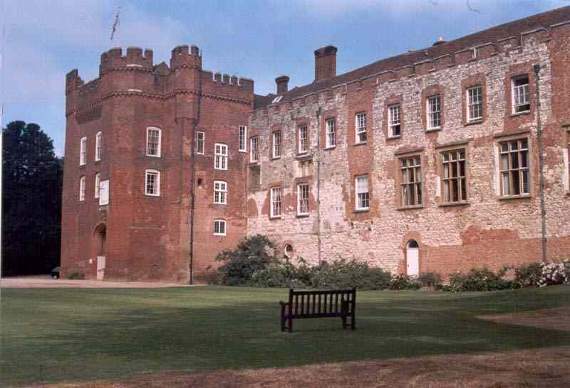
Richard Foxe, Bishop of Winchester and resident at Farnham Castle, was one of the key architects of the Tudor dynasty, yet today remains largely overlooked.
He was an intimate of both Henry VII and Henry VIII, a chief diplomat, an educationalist (he founded Corpus Christi College, Oxford), and was a mentor to Thomas More, William Warham, Thomas Wolsey, and John Fisher.
Born into a relatively modest Lincolnshire family circa 1447, he was bright enough to go to both Oxford and Cambridge universities.
Foxe first met Henry Tudor, the Earl of Richmond, in Paris where the latter was trying to win support from the King of France, in his endeavours to take the English crown from Richard III.




Henry appears to have been very impressed by Foxe as when Henry departed France he chose Foxe to stay behind, according to Fulman, an early biographer, ‘to pursue his negotiations at the French court, which he performed with such dexterity and success as gave great satisfaction to the earl’.
It was by some accounts Richard Foxe who brought news of Henry Tudor's victory against Richard III at the Battle of Bosworth Field on August 22, 1485. The new King immediately made Richard Foxe a member of his new council and he rose extremely rapidly through the ranks to become Lord privy seal and Bishop of Exeter. In fact, before Foxe, there was no title of ‘Lord’ Privy Seal, but he kept the position for so long that whoever holds this post now has this title.
In 1491, King Henry VII asked Foxe to baptise his second son Prince Henry, who later became Henry VIII and was also named as his godfather.
In 1494, Henry VII, once again, demonstrated his utter faith in Foxe by making him Bishop of Durham where his diplomatic talents could be put to good use in dealing with Scotland. It was Foxe who was key in negotiating two important marriages which have left a remarkable legacy. In 1503, he oversaw the marriage of Margaret Tudor, Henry VII’s eldest daughter, to the Scottish King, James IV, which resulted in the permanent Union of the English and Scottish crowns.
The second marriage, in which Foxe played a leading role, was between Prince Arthur, eldest son of Henry VII, and Catherine of Aragon in November 1501. Foxe, as Lord Privy Seal, went to meet the young Spanish princess when she arrived in Plymouth, and escorted her to London - the details of these plans still survive in Foxe’ s own hand. By this time Foxe had moved from Durham to the plum seat of Winchester, the richest see in England, as King Henry was keen to have him nearer the royal court. When in February 1503, William Warham was made Archbishop of Canterbury, Foxe is reputed to have snapped to Warham that “Canterbury had a higher seat but Winchester was more succulent”, clearly alluding to the immense wealth of the latter.
When Henry VII died in April 1509, Foxe was one of his executors. The king had especially requested that Foxe look after the young Prince, now King Henry VIII. Foxe was now very keen that young Henry should marry Catherine, widow of Prince Arthur who had died seven years earlier. It seems he never questioned the legitimacy of the marriage which would later come to haunt the throne.
Henry VIII kept Foxe in his powerful position at court, along with Thomas Howard, Earl of Surrey. There was, however, a deep-seated enmity between these two ministers of state, where mutual jealousies and differences arose, not least over financial matters. Foxe had always been extremely careful to amass and then preserve the King’s wealth, but Surrey had a propensity to squander it.
Foxe’s influence began to wane at the same time as that of Thomas Wolsey was rising - but there is no real evidence that Wolsey sought to usurp Foxe’s position and in fact, Foxe actively supported Thomas Wolsey in his career, originally bringing him to the attention of King Henry VII who made Wolsey his private chaplain.
In 1514, the Venetian ambassador reported that Foxe was ‘ a Lord of extreme authority and goodness’ but by then he was weary of court politics and the valuable work he had achieved in keeping England out of expensive wars, was by now, rapidly unravelling, especially as relations with France deteriorated.
Foxe retired from politics to focus his life on the quiet discharge of his episcopal duties as Bishop of Winchester. It seems he was almost totally blind in the 10 years before his death, hence the story of the construction of the Blind Bishop’s Steps at his residence in Farnham.
Foxe died on the October 5, 1528, succeeded as Bishop of Winchester by his protégé, Thomas Wolsey. His career was monumental in cementing the power and legitimacy of the Tudors - although in hindsight we could also suggest that in promoting the marriage between Henry VIII and Katherine of Aragon, he also helped sow the seeds of its downfall.
Comments
This article has no comments yet. Be the first to leave a comment.