
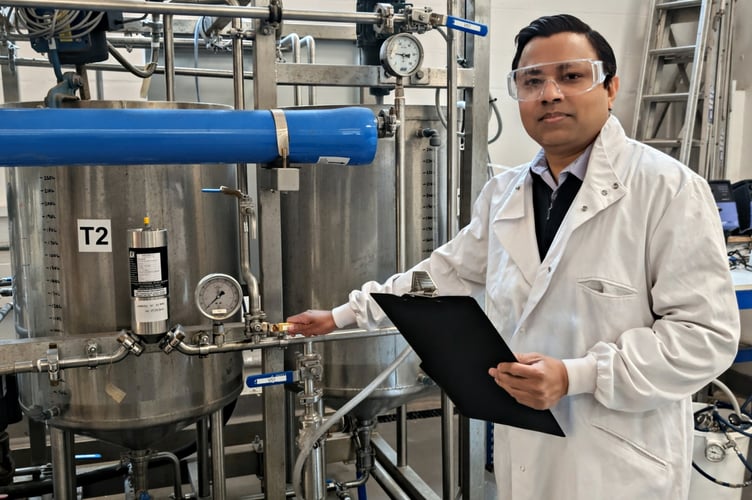
Human urine could help tackle global fertiliser and wastewater challenges, according to new research from the University of Surrey.
Often flushed away without thought, it could in fact play a key role in making agriculture and wastewater treatment more sustainable and energy efficient, researchers say.
Although urine makes up around one percent of wastewater, it contains most of the nutrients needed for plant growth, including nitrogen, phosphorus and potassium.
In a study published in the Journal of Environmental Chemical Engineering, researchers examined how these nutrients can be recovered and reused by concentrating urine into a fertiliser-rich stream.




Using a low-energy process known as forward osmosis, the team removed water while retaining high levels of nutrients, avoiding the high energy demands of conventional wastewater treatment methods.
The approach could reduce pressure on treatment plants while supporting more sustainable fertiliser production.
Dr Siddharth Gadkari, lecturer in chemical process engineering at the University of Surrey and lead author of the study, said: “It is strange to say, but it has the added benefit of being true – our pee is an underutilised resource.
“Even though it contains the key nutrients we need for agriculture, we currently treat it as waste. Our research shows that with the right treatment approach, we can recover these nutrients efficiently while reducing the energy demands of wastewater treatment.”
A major challenge for membrane-based systems is fouling, where biological and organic material builds up on surfaces over time and reduces performance.
The study provides detailed insight into how human urine behaves under repeated operation, including how different conditions affect fouling, efficiency and cleaning.
Researchers found that simple pre-treatment steps, such as filtration, can significantly improve performance, while most fouling can be reversed through cleaning, making the system more viable for long-term use.
Dr Gadkari added: “What is particularly exciting is that we have demonstrated how this system behaves under realistic conditions using real human urine.
“If we can effectively manage fouling, this technology can move much closer to practical, long-term use.”
The research was carried out in collaboration with the University of KwaZulu-Natal in South Africa, where source-separated urine systems are already being explored at scale.
Researchers believe the work could help reduce reliance on energy-intensive fertiliser production, lower carbon emissions and support more sustainable water and nutrient management worldwide.
Comments
We've recently changed our login process. If you have an account for commenting, you will need to re-register on the login window.
This article has no comments yet. Be the first to leave a comment.