
“Twit twoo!” is what many people say when asked to describe the sound of an owl.
-John-Bridges.jpeg?width=209&height=140&crop=209:145,smart&quality=75)



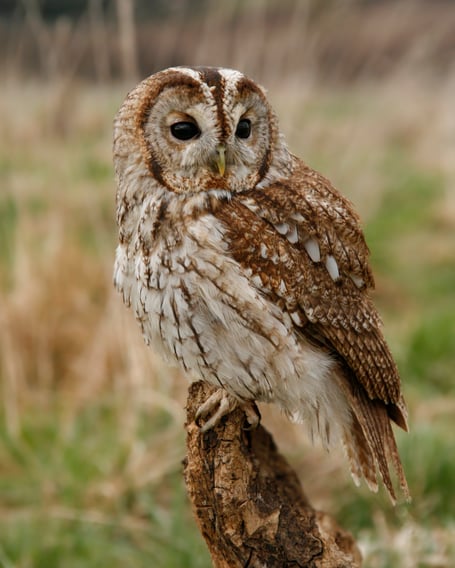
But that’s wrong, strictly speaking. “Twit twoo” is actually the calls of two owls – a male and a female. The female calls “Twit” to a male, who responds with a longer “too-woo”. And the “twitting” and “twooing” is confined to the tawny owl, our biggest common owl species; other owls have their own sounds.
Around now, early spring, is a good time of the year to hear owls in the UK because they’re courting (t-wooing – sorry, couldn’t resist that!) and staking out territories. They are vocal from dusk all through the night, especially on crisp, clear evenings.
There are several good, concise guides to British owls online. They include a guide from Surrey Wildlife Trust (SWT) to the five resident owl species found in the UK: barn owl, little owl, long-eared owl, short-eared owl and tawny owl: visit https://tinyurl.com/nandm-owl-id
SWT also has a fun quiz “How well do you know Surrey’s owls?” – they say “it’s a hoot” (boom-boom!).
Visit https://tinyurl.com/nandm-owlquiz – in which I surprised myself by scoring 9 out of 9, entirely due to my constant reading about nature topics for I’m by no means an owl expert.
Tackle the quiz if only for its entertainment value, as each correct answer prompts a comical owl-related pun!
SWT says the tawny owl is the owl species most often spotted in Surrey. They benefit from the heavily-wooded nature of the county and can be seen and heard in many of SWT’s reserves such as Cucknell's Wood, Wallis Wood and Nower Wood, and in many parks and gardens.
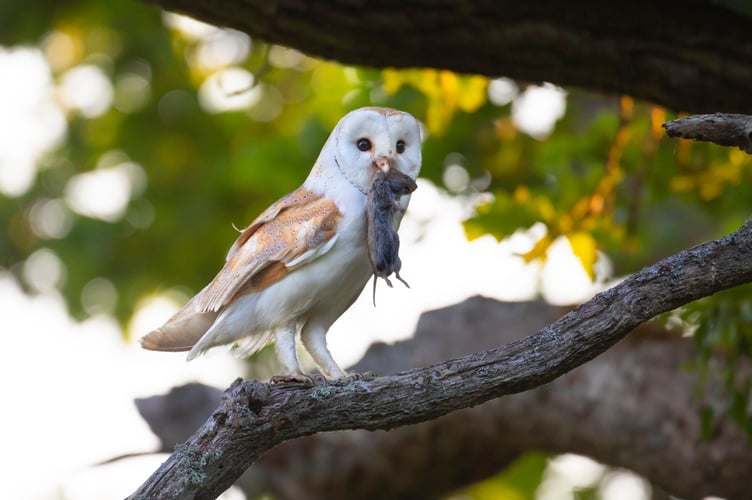
It’s well-known that owls are primarily birds of the night, although the short-eared owl hunts during the day as well as at night. The barn owl is most the likely to be spotted, flying low over open farmland, fields and hedgerows at dawn and dusk; it is arguably our most-loved owl, thanks to its heart-shaped face and pure white feathers, which makes easy to identify.
Owls come out at night because they are specially adapted to find food and stay safe during that time. They rely on senses built for darkness, and night-time gives them opportunities to prey on unsuspecting creatures, especially rodents that are also awake after dark.
Night also means they don’t have to compete with predators that rely on daylight – buzzards, kites and other raptors may rule the skies in daylight, but owls quietly rule during the night.
Owls are specially adapted to let them see when it’s almost totally dark. Their eyes are huge and gather much more light than ours.
Inside, their retinas are packed with rod cells, which work better in low light. That means owls can spot movement and shapes even when there’s hardly any light.
With both eyes facing forward, they get great depth perception, which helps them swoop down on prey at just the right moment.
Owls also have very sharp hearing and nearly silent flight. By using these and their excellent night-time eyesight they can find and catch prey quietly and with scary accuracy.
We are more likely to hear an owl than to see it as most of them are out and about when we are tucked up inside, and they’re all well camouflaged.
Fortunately the Woodland Trust has an excellent guide to our five native owl species’ calls: visit https://tinyurl.com/nandm-owl-calls
Comments
We've recently changed our login process. If you have an account for commenting, you will need to re-register on the login window.
This article has no comments yet. Be the first to leave a comment.