
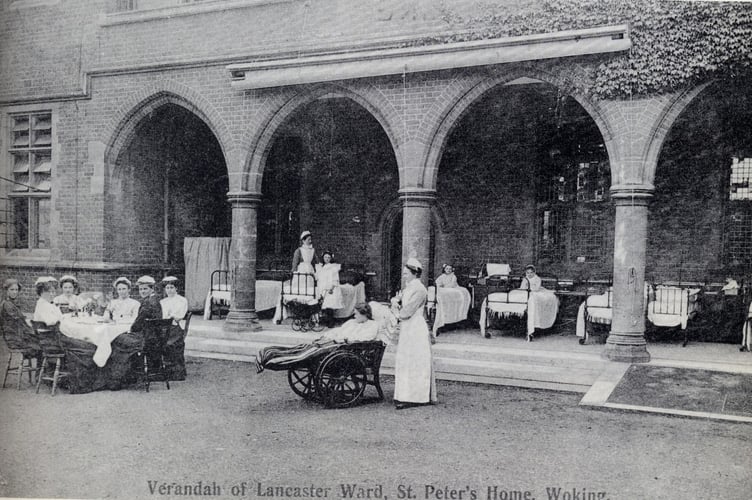
STUDYING old postcards not only gives a glimpse of how places looked years ago, but can reveal which views were most popular with those who bought them.
For more than 40 years I have been collecting topographical picture postcards, including my home town of Guildford, villages in Surrey and, of course, the Woking area.
They can be sourced from antique and junk shops, specialist postcards fairs and, as in more recent times, from online auction websites. Sometimes I’ve been given cards from generous people, to whom I’m always grateful.
Aside from the ubiquitous seaside postcard views, it’s thought that from the time when picture postcards first became popular at the turn of the 20th century up until just after the First World War, every UK city, town, village, hamlet and even street corner was featured on a postcard!


The craze was to collect them and put them into albums, which is why so many have survived.
The hundreds of postcard publishers soon knew that landmark buildings and places of interest were their bestsellers, so these vintage postcards are the most common examples found today by collectors.
Another theme for which I’m sure good sales were guaranteed was postcards of places attracting plenty of people, all keen to buy a postcard showing where they were staying or visiting.
One such place was St Peter’s Convent on Maybury Hill, Woking. Surviving postcards of it I would say are fairly common and the building was featured on postcards over many years, even up until about the 1980s. Today it is St Columba’s House, a Christian retreat and conference centre.
Its origins go back to 1861 when London businessman Benjamin Lancaster founded, in Brompton Square, an Anglican religious community called the St Peter’s Sisterhood, its focus being on health and care for people.
In 1869 it moved to Kilburn, while in 1883 land was bought in Woking and St Peter’s Convent and Memorial Home was built and opened in 1885. The word “memorial” in the title was in memory of Mr Lancaster’s wife.
Woking historian Iain Wakeford has noted the sisterhood’s mission for the home was for “incurables” and to “admit patients that were refused other homes”.
The website of St Columba’s House adds that over the decades the Woking complex had a convent, a hospital, a home for the elderly, a guest house, a home for adults with learning difficulties and a retreat house.
It adds that by the late 1980s the numbers of sisters had dwindled and the convent was sold. Although a new nursing home and convent was opened in 1998, sadly it closed in 2002.
Today’s retreat was founded in 1967, while, in 2009, St Columba’s House was extended and refurbished.
Of the postcards featured here, the one titled Woking, St Peter’s Convalescent Home, was posted and the message on the back may just be that it was written and sent by someone who was staying at the home.
It’s postmarked WOKING SP 11 05. Sent to Mrs Gurney, East View, Miswell Lane, Tring,
The sender, who signed it with the initial W, wrote: “Arrived quite safe after a wet ride / had rain half way / will you ask the boss if I can have Friday together / because we want to go out.”
IF you have memories or old pictures relating to the Woking area and its people which you would like to contribute to this column, call David Rose on 01483 838960, or write to the News & Mail.
David Rose specialises in what he calls ‘the history within living memory’ of people, places and events in West Surrey, covering towns such as Woking and Guildford. He collects photos and memorabilia relating to the area, and gives illustrated local history talks to groups and societies. For enquiries and bookings, email [email protected].
Comments
This article has no comments yet. Be the first to leave a comment.